✦ Complete Travel Guide 2026 ✦
Uruguay — South America’s
Most Underrated Gem
From Montevideo’s soulful waterfront to Punta del Este’s glamorous shores — your definitive guide to exploring Uruguay
Introduction to Uruguay
Tucked between the giant shadows of Brazil and Argentina, Uruguay is a small nation that punches enormously above its weight — in culture, quality of life, natural beauty, and sheer livability.
Uruguay sits in the southeastern corner of South America, bordered by Brazil to the north and northeast, Argentina to the west, and the South Atlantic Ocean and Río de la Plata to the south and southeast. Despite covering just 176,000 square kilometres — roughly the size of England and Wales combined — Uruguay manages to pack in a remarkable diversity of landscapes: rolling green grasslands, pristine Atlantic beaches, charming colonial towns, and a buzzing cosmopolitan capital.
What truly sets Uruguay apart is not geography but character. This is a nation with one of Latin America’s highest literacy rates, a deeply secular democracy, progressive social policies (Uruguay was among the first countries globally to fully legalize cannabis and same-sex marriage), and a cultural openness that makes visitors feel instantly at ease. The Economist Intelligence Unit has repeatedly ranked Uruguay as one of South America’s most stable and prosperous democracies.
For travelers, Uruguay offers something rare: an authentic South American experience without the overwhelming scale or security concerns of its neighbours. The people — called Uruguayans or orientales — are famously warm, unhurried, and proud. Whether you are sipping mate on the Rambla at dawn, exploring century-old estancias in the interior, or dancing until sunrise in Punta del Este, Uruguay has a quiet magic that stays with you long after you leave.
🌟 Why Uruguay Stands Out
- One of South America’s safest and most politically stable countries
- Over 660 km of stunning Atlantic and Río de la Plata coastline
- Exceptional food scene blending Indigenous, Spanish, Italian, and African influences
- Year-round warm climate ideal for outdoor exploration
- Progressive social policies and high Human Development Index ranking
- Compact size — most major destinations are within a few hours of Montevideo
Capital City – Montevideo
Montevideo is one of South America’s most liveable, walkable, and culturally rich capitals — a city where colonial grandeur and café culture coexist with contemporary arts and an irresistible Atlantic energy.
History of Montevideo
Founded by the Spanish in 1724 on a peninsula jutting into the Río de la Plata, Montevideo grew from a strategic military outpost into the thriving capital of an independent Uruguay by 1830. The city absorbed waves of immigrants — Spanish, Italian, French, African, and later Eastern European — each layering their own textures onto the urban fabric. The result is a city of extraordinary architectural eclecticism: Baroque cathedrals stand beside Art Deco towers, and Portuguese-tiled facades neighbour sleek glass offices in the financial district.
The Ciudad Vieja (Old City) is the historical beating heart of Montevideo, home to the Plaza Independencia — Uruguay’s most iconic public square, dominated by the imposing mausoleum of national hero José Artigas — and the colonial-era Cabildo, Uruguay’s oldest public building. Walking through Ciudad Vieja on a Saturday morning, when local artisan markets spill across the cobblestones, is one of travel’s genuine pleasures in Uruguay.
Culture and Lifestyle in Montevideo
Montevideo’s culture is defined by a certain tranquilidad — a peaceful, unhurried approach to life that can feel almost revolutionary to visitors from faster-paced cities. The café is a social institution here. Residents linger over espresso for hours, debating football (soccer is a near-religion in Uruguay), politics, and literature. Uruguay has produced a disproportionately large number of celebrated writers for its size, including Eduardo Galeano, Mario Benedetti, and Juan Carlos Onetti.
The city’s cultural calendar is exceptionally rich. The Montevideo Carnival — held every February — is the longest carnival in the world, running for over 40 days and featuring murgas (satirical musical theatre groups), candombe drum processions rooted in Afro-Uruguayan heritage, and neighbourhood street parties that pulse with infectious energy.
“Montevideo is a city that rewards slowness. The more time you give it, the more it gives back.” — Travel & Leisure Magazine
Neighbourhoods Worth Exploring
- Ciudad Vieja — Colonial architecture, antique shops, and the city’s best museums
- Palermo & Cordón — Bohemian cafés, independent bookshops, and weekend flea markets
- Pocitos — Beachfront neighbourhood with a young, cosmopolitan vibe and great restaurants
- Carrasco — Elegant tree-lined streets and the city’s most exclusive residential enclave
- Punta Carretas — Upscale dining, boutique shopping, and the famous converted-prison mall
Currency of Uruguay
The official currency of Uruguay is the Uruguayan Peso (UYU), symbolised as $ or UY$. As of 2026, the exchange rate hovers around 40–45 UYU per US Dollar, though this fluctuates with market conditions. Travelers should always check the current rate before arrival.
💱 Essential Currency Facts for Travelers
- Currency: Uruguayan Peso (UYU / UY$)
- Approximate rate: ~40–45 UYU per USD (verify before travel)
- USD and Argentine Pesos are widely accepted in Punta del Este and tourist areas
- ATMs (called cajeros automáticos) are widely available in Montevideo and major towns
- Credit cards (Visa, Mastercard) accepted at most restaurants, hotels, and shops
- VAT (IVA) in Uruguay is 22%; tourists can sometimes claim refunds at the airport
- Tipping is customary: 10% in restaurants is standard practice
Uruguay’s economy is one of South America’s most stable, bolstered by strong agriculture (beef, soy, dairy), a growing technology sector, and a well-regulated financial system. For travelers, this means a reliable, predictable travel environment. Prices in Uruguay are somewhat higher than neighbouring Argentina but remain excellent value compared to Western Europe or North America. A mid-range traveler can expect to spend approximately USD 60–100 per day including accommodation, meals, and local transport.
One practical note: Uruguay’s banks often have different official and tourist exchange rates. Money exchange bureaus (casas de cambio) typically offer better rates than airport kiosks. It is advisable to carry some cash for smaller towns, markets, and beach vendors who may not accept cards.
The Rambla — Montevideo’s Soul by the Water
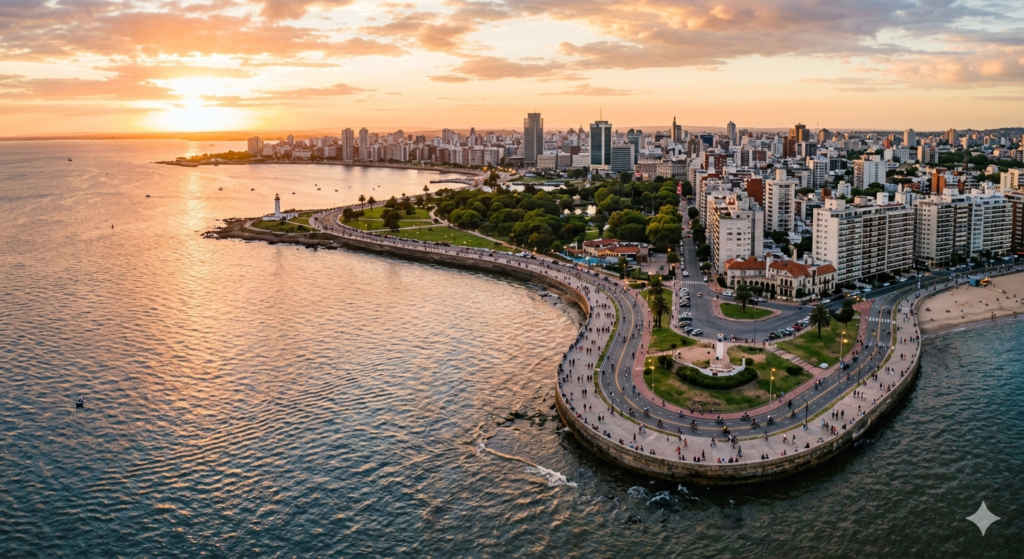
If there is one structure that defines Montevideo more than any other, it is the Rambla — a 22-kilometre coastal promenade that serves as the city’s open-air living room, sports arena, social hub, and daily refuge all at once.
The Rambla de Montevideo stretches along the city’s entire southern waterfront, from Ciudad Vieja in the west to the wealthy suburb of Carrasco in the east, tracing the banks of the Río de la Plata. Built in stages through the early and mid-20th century, the Rambla was designed not as a tourist attraction but as a public space for ordinary Montevideans — and that democratic, inclusive spirit endures to this day.
Cultural and Social Significance
On any given morning, the Rambla is alive with runners, cyclists, dog walkers, and elderly couples sharing mate from shared termos (thermoses). On weekend afternoons, families spread blankets on the grass verges. At sunset, couples watch the sky over the Río de la Plata turn shades of amber and rose. The Rambla is perhaps the most powerful expression of Uruguay’s egalitarian spirit — everyone, regardless of class or background, uses and belongs here.
Mate culture is nowhere more visible than on the Rambla. Uruguayans are the world’s highest per-capita consumers of mate, the herbal tea drunk from a gourd through a metal straw (bombilla). Seeing a grandmother, a group of teenagers, and a businessman all cradling their mate gourds while walking the Rambla is a quintessential Montevideo experience.
Scenic and Recreational Value
The Rambla connects Montevideo’s main beaches — Playa Pocitos, Playa Buceo, Playa Malvín, and Playa Carrasco among others — each with its own character and local devotees. The promenade also passes several historic fortifications, fishing piers, and open-air sculpture installations. The Fortaleza General Artigas and the Cerro de Montevideo (the hill that gave the city its name) can be seen from various points along the route.
🌊 Rambla Quick Facts
- Total length: 22 kilometres — one of the longest urban promenades in the world
- Connects: Ciudad Vieja to Carrasco along the Río de la Plata
- Best time to walk: Sunrise for golden light and mate culture; sunset for dramatic skies
- Cycling: Dedicated bike lanes run the entire length — bikes available for rent
- Free to access 24 hours a day, 365 days a year
Top Places to Visit in Uruguay
Uruguay may be compact, but it is extraordinarily varied. From Atlantic beach towns to gaucho country to preserved colonial villages, here are the destinations that belong on every traveler’s Uruguay itinerary.
🏙 Montevideo
The capital and cultural heart of Uruguay. Don’t miss Ciudad Vieja, the Mercado del Puerto, and the Rambla at sunset.
🏖 Punta del Este
South America’s most glamorous resort city — famous for beaches, nightlife, world-class restaurants, and celebrity visitors.
🏛 Colonia del Sacramento
A UNESCO World Heritage-listed Portuguese colonial town, 50 minutes by ferry from Buenos Aires. Cobblestone streets and riverside charm.
🌿 Cabo Polonio
An off-grid coastal village accessible only by 4×4, home to sea lions, lighthouse views, and an extraordinary sense of solitude.
🌲 Punta del Diablo
A bohemian fishing village turned surfer haven. Raw, authentic, and less developed than Punta del Este — beloved by backpackers.
🏺 Fray Bentos
Home to a UNESCO-listed industrial museum — the former Liebig meat extract factory that fed Europe for decades.
🌊 La Paloma
A quiet Atlantic beach town known for excellent surfing, fresh seafood, and a relaxed coastal lifestyle away from the crowds.
🐄 Tacuarembó
The gaucho heartland of Uruguay. Visit in March for the Festival de la Patria Gaucha — one of South America’s great cultural festivals.
♨️ Termas del Daymán
Natural thermal hot springs near Salto, where Uruguayans go year-round to relax in open-air mineral pools.
Colonia del Sacramento — Uruguay’s Colonial Jewel
Founded by the Portuguese in 1680, Colonia del Sacramento is Uruguay’s most visited historic site — and for good reason. Its Old Quarter (Barrio Histórico), a UNESCO World Heritage Site since 1995, is a labyrinth of cobblestone lanes lined with bougainvillea-draped colonial houses, antique lampposts, and centuries-old ruins that speak of Portuguese, Spanish, and British occupation. The view over the Río de la Plata from the old lighthouse at golden hour is one of Uruguay’s most photographed images. A day trip from Buenos Aires by high-speed ferry makes Colonia one of the most accessible international experiences in South America.
Cabo Polonio — Uruguay’s Wild Atlantic Frontier
For travelers craving something genuinely off the beaten path, Cabo Polonio is unmissable. There is no paved road, no mains electricity, no piped water. Access requires a jarring 45-minute journey by giant 4×4 truck across sand dunes. What awaits is a small village of wooden cabins perched among dunes, a working lighthouse, and one of the largest South American sea lion colonies on the continent. At night, Cabo Polonio achieves an almost total darkness punctuated only by stars. It is, by many accounts, one of the most extraordinary places in Uruguay.
Punta del Este — Uruguay’s Glamorous Riviera
Punta del Este is to Uruguay what the French Riviera is to France — a byword for glamour, excess, beauty, and the kind of leisure that the very wealthy and the simply sun-hungry both pursue with equal devotion.
Overview of Punta del Este
Located approximately 140 kilometres east of Montevideo along the Atlantic coast, Punta del Este occupies a narrow peninsula where the Río de la Plata meets the South Atlantic Ocean — meaning it has beaches on two sides with notably different characters. The western (playa mansa, or calm beach) side faces the river and is gentler, ideal for families and watersports. The eastern (playa brava, or rough beach) side faces the open ocean, with powerful Atlantic swells that attract surfers and experienced swimmers.
The city rose to prominence in the mid-20th century when wealthy Argentineans and Brazilians began building summer estates here. Today it is one of South America’s most internationally recognised resort destinations, attracting celebrities, politicians, business magnates, and regular travelers alike. In summer (December–February), the population swells from around 10,000 permanent residents to over 300,000 visitors.
Things to Do in Punta del Este
Beaches
- Playa Brava — The iconic beach dominated by the La Mano sculpture (Fingers), emerging from the sand. A must-photograph Uruguay landmark
- Playa Mansa — Calmer waters on the river side; perfect for families, paddleboarding, and sunset watching
- Playa de los Ingleses — A quieter beach favoured by locals seeking respite from the main tourist strips
- José Ignacio Beach — 30 km east of Punta, this bohemian fishing village has become Uruguay’s most exclusive and fashionable beach spot
Nightlife and Entertainment
Punta del Este’s nightlife is legendary throughout South America. The city’s clubs and bars don’t truly come alive until well past midnight, and some of the world’s most famous DJs have performed at venues along Avenida Gorlero and the beach clubs that line the coast. Moby Dick, Tequila, and the outdoor beach clubs of Chihuahua Beach are perennial favourites. Summer weekends can feel like one extended outdoor festival — a democratic mix of elegance and exuberance that is quintessentially Uruguayan.
Landmarks and Cultural Attractions
- La Mano (The Hand) — Mario Irarrázabal’s giant hand sculpture emerging from Playa Brava sand is Uruguay’s most reproduced image
- Isla Gorriti — A small forested island accessible by water taxi, with colonial ruins, walking trails, and superb views back to Punta’s skyline
- Museo Ralli — One of Uruguay’s finest private museums, housing an outstanding collection of contemporary Latin American and European surrealist art, free admission
- Cantegril Country Club — Historic golf and tennis club open to visitors, offering a glimpse into Punta’s century of leisure culture
- Puerto de Punta del Este — The yacht-filled marina at the tip of the peninsula, lined with excellent seafood restaurants and café terraces
Activities Beyond the Beach
- Whale watching (July–October) from Punta Ballena, just west of Punta del Este
- Casapueblo — the extraordinary whitewashed artist’s studio-turned-hotel by Carlos Páez Vilaró at Punta Ballena, now a museum and cultural icon
- Windsurfing and kitesurfing on Playa Mansa
- Day trip to the sea lions at Isla de Lobos, the largest sea lion colony in the Southern Hemisphere
- World-class dining — Punta del Este has several restaurants ranked among Latin America’s finest
Local Food Culture in Uruguay
Uruguayan food culture is honest, hearty, and deeply rooted in agricultural tradition — a cuisine built on the premise that excellent ingredients, treated with respect, need little embellishment.
At the centre of Uruguayan food culture is beef. Uruguay is one of the world’s great beef-producing nations, with cattle grazing on natural grasslands in a ratio of roughly four cows per person. The asado (barbecue) is a near-sacred ritual here, presided over by the asador with an almost religious seriousness. A proper Uruguayan asado includes multiple cuts — ribs, sausages (chorizos), blood sausage (morcilla), and offal — cooked low and slow over wood embers for several hours.
Other culinary staples include the chivito (Uruguay’s national sandwich: a towering construction of beef, ham, mozzarella, olives, egg, and tomato in a soft roll), empanadas, and milanesa (breaded cutlet). The Mercado del Puerto in Montevideo’s Ciudad Vieja is the finest temple to this meat-loving food culture, with rows of charcoal grills visible from the street and the scent of wood smoke permeating the surrounding blocks.
Dulce de Leche — Uruguay’s Beloved Sweet
If beef is Uruguay’s savoury soul, then dulce de leche is its sweet one. This gloriously indulgent caramel-like spread, made by slowly heating sweetened milk until it caramelises to a thick, amber, silky consistency, is present in virtually every aspect of Uruguayan cuisine and daily life.
The History of Dulce de Leche
The exact origin of dulce de leche is hotly contested throughout South America — both Uruguay and Argentina claim it as their own, and Brazil, Chile, and Colombia have their own versions. One popular legend attributes its discovery to a careless cook in early 19th-century Argentina who left sweetened milk on the stove and returned to find it transformed. The historical reality is that similar preparations have existed in South America since the colonial period, likely derived from European techniques brought by Spanish settlers combined with abundant local dairy.
In Uruguay, dulce de leche production became industrialised in the 20th century, and today iconic brands like Conaprole (Uruguay’s largest dairy cooperative) produce it in enormous quantities for domestic consumption and export. The quality of Uruguayan dulce de leche is genuinely exceptional — made from the milk of grass-fed cattle, it has a depth of flavour that mass-produced versions elsewhere cannot match.
How Dulce de Leche Is Used in Uruguay
- Spread on toast or fresh bread at breakfast — the most common daily use
- Filling for alfajores (shortbread cookies sandwiched with dulce de leche and coated in chocolate or powdered sugar)
- Inside facturas (pastries) from the ubiquitous panaderías (bakeries)
- Ice cream flavour — dulce de leche ice cream is the most popular in Uruguay by an enormous margin
- Cake fillings, crepe toppings, and churro dips
- Eaten directly from the jar with a spoon — a guilty pleasure Uruguayans freely confess to
🍮 Traveler Tip: Bringing Dulce de Leche Home
Dulce de leche in sealed jars is generally permitted through airport security and customs in most countries. Buy from a supermarket (supermercado) rather than tourist shops for better prices — Conaprole and Laquey brands are both excellent choices to bring as gifts.
Essential Travel Tips for Uruguay
Planning a trip to Uruguay requires some preparation but rewards those who invest the effort with one of South America’s most satisfying travel experiences. Here is everything you need to know before you go.
| Category | Key Information |
|---|---|
| Best Time to Visit | December–March (summer) for beach resorts; April–November for Montevideo and cultural travel with fewer crowds and lower prices |
| Climate | Temperate; warm summers (25–35°C), mild winters (8–15°C). Rain is distributed year-round — pack a light jacket even in summer |
| Safety | Uruguay is one of South America’s safest countries. Petty theft exists in urban areas — standard precautions apply. Violent crime against tourists is rare |
| Visa Requirements | Citizens of EU, USA, Canada, Australia, and most South American nations receive a free 90-day tourist visa on arrival. Always verify current requirements before travel |
| Getting Around | Excellent intercity bus network (Tur Bus, COT, Copay). Rental cars recommended for rural exploration. Montevideo has a reliable bus and taxi network |
| Language | Spanish. English is spoken in major hotels and tourist areas but less common in smaller towns. A phrasebook or translation app is useful |
| Health | No mandatory vaccinations for most nationalities. Tap water is generally safe to drink in Montevideo and major cities. Travel insurance strongly recommended |
| Budget | Budget: USD 40–60/day; Mid-range: USD 80–130/day; Luxury: USD 200+/day. Punta del Este is significantly more expensive than the rest of the country, especially in high season |
| Connectivity | Excellent mobile coverage and Wi-Fi nationwide. Local SIM cards (Antel, Movistar, Claro) available cheaply at airports and city centres |
| Electricity | 230V / 50Hz. Uruguay uses a unique Type L plug (three-pin at 120°). Carry an adapter — Type C and Type F adapters also often work in older sockets |
Practical Tips from Experienced Travelers to Uruguay
- Carry cash for smaller destinations — card acceptance is excellent in Montevideo and Punta del Este but patchy in rural areas and beach villages like Cabo Polonio
- Book high season accommodation early — Punta del Este accommodation sells out months in advance for December–February. Book by September at the latest
- Try the local supermarkets — Uruguayan supermarkets like Disco and Devoto are excellent for affordable, high-quality local products including wine, cheese, and dulce de leche
- Respect the mate ritual — if offered mate, accept graciously. It is a social gesture of trust and friendship. Never add sugar unless offered; drink all the liquid in the gourd before passing back
- Use intercity buses — Uruguay’s long-distance bus system is comfortable, punctual, affordable, and air-conditioned. For most journeys under 4 hours, it beats flying
- Visit the Mercado del Puerto on a Saturday — the Montevideo meat market is at its most vibrant on Saturday lunchtimes, when grill smoke fills the iron-framed hall
- Sun protection is essential — Uruguay’s UV index can be extreme in summer, even on overcast days. High-SPF sunscreen, hats, and protective clothing are must-haves
Conclusion
Uruguay is a country that rewards those who discover it. In a continent often defined by extremes — of scale, intensity, and complexity — Uruguay offers something more nuanced and perhaps more lasting: a small nation with a large soul, where quality of life, democratic values, and genuine warmth toward visitors combine to create an experience that rarely disappoints.
Whether you spend a long weekend on the cobblestones of Colonia del Sacramento, a summer season on the beaches of Punta del Este, a week soaking up Montevideo’s café culture and magnificent Rambla, or a fortnight exploring the interior’s gaucho traditions and natural thermal springs — Uruguay will leave its mark on you. It is a place where the pace of life feels just right, where dulce de leche improves almost everything, and where the sunset over the Río de la Plata is genuinely one of the most beautiful sights in the Southern Hemisphere.
For any traveler who has yet to discover Uruguay — the time is now. This is South America’s best-kept secret, and it will not remain so forever.
📌 Plan Your Uruguay Trip
Ready to explore Uruguay? Visit the official Uruguay Tourism Ministry website for updated entry requirements, regional guides, and accommodation listings. For ferry connections from Buenos Aires to Colonia or Montevideo, check Buquebus for schedules and pricing.
Frequently Asked Questions About Uruguay
Is Uruguay safe for tourists?
Yes. Uruguay consistently ranks as one of South America’s safest countries for travelers. Violent crime against tourists is rare. Standard urban precautions — avoid displaying valuables, be alert in busy public areas — are all that most visitors need. Montevideo and Punta del Este both have active tourism police and well-maintained tourist infrastructure.
What is the best time of year to visit Uruguay?
It depends on what you’re looking for. For beach holidays and Punta del Este’s famous nightlife, December through February (Southern Hemisphere summer) is peak season. For exploring Montevideo, Colonia del Sacramento, and the interior without crowds or high prices, March through November is ideal. The Montevideo Carnival in February is a highlight worth timing your trip around.
Do I need a visa to visit Uruguay?
Most Western and South American passport holders receive a free 90-day tourist visa on arrival. This includes citizens of the USA, Canada, the EU, the UK, Australia, and New Zealand. Always verify current requirements with the Uruguayan consulate or embassy in your country before traveling, as policies can change.
What currency does Uruguay use and can I pay in US dollars?
Uruguay’s official currency is the Uruguayan Peso (UYU). US dollars are widely accepted in Punta del Este, major hotels, and tourist-oriented businesses throughout the country. However, smaller shops, markets, and services in less-touristed areas will typically only accept Uruguayan Pesos. It is always advisable to carry some local currency.
How do I get from Montevideo to Punta del Este?
The most common route is by intercity bus. Companies like COT and Copay run frequent, comfortable, air-conditioned services between Montevideo’s Tres Cruces bus terminal and Punta del Este, taking approximately 2 hours. Rental cars are also a popular option for exploring the coast at your own pace. Driving time is roughly 1.5 hours via the Interbalnearia highway.
What should I eat in Uruguay?
Start with an asado (barbecue) — Uruguay’s beef is world-class. Try a chivito sandwich, the national comfort food. Explore dulce de leche in every form — on toast, inside alfajores, in ice cream. Drink mate to experience local culture. And don’t miss fresh seafood in coastal towns like La Paloma or the Mercado del Puerto in Montevideo for an authentic grilled meat experience.
Is Uruguay expensive to travel in?
Uruguay is mid-range by South American standards — more expensive than Paraguay, Bolivia, or parts of Peru, but significantly cheaper than Brazil’s resort areas or Chile’s major cities. Budget travelers can manage on USD 45–60/day, mid-range travelers on USD 80–130/day, and luxury options are available throughout. Punta del Este in high season is considerably more expensive than the rest of the country.
What is the Rambla in Montevideo?
The Rambla is Montevideo’s iconic 22-kilometre waterfront promenade running along the Río de la Plata from Ciudad Vieja to Carrasco. It is the social heart of the city — used daily for walking, running, cycling, mate drinking, and socialising. It is free, open 24 hours, and arguably the best single place in Uruguay to experience local everyday life.